
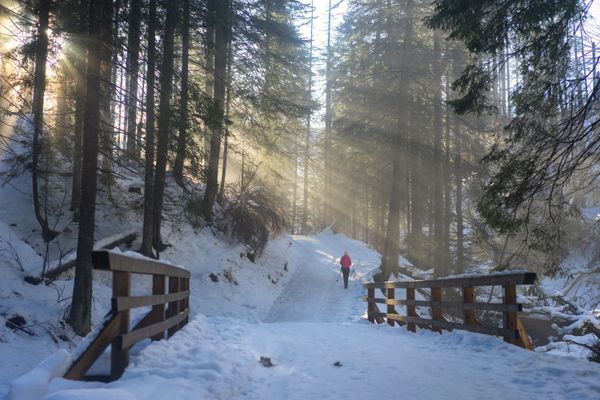
1. Know your location
You may choose a familiar hiking location for your winter adventure. However, you should take note that some places may have changes in appearance especially when snowfalls. So it’s important that you study the trail you’re taking or at least have your map and compass readily available.
Winter Trick: During this time of the year, the length of the day is shorter. So take into consideration the setting of the sun. If you plan not to have an overnight camp, better set out earlier on your hike.
2. Prepare your gears
One of the most important investments in my hiking life is my gear. If my gears are in their best condition and appropriate for the weather for which I’m using them, then I’m all set. Here are what I consider when preparing my gear for a snowy hike.
a) Winter Hiking Gear
You may say you already have your hiking gear all set. But don’t forget of the word winter. The ground is barely visible with all the snow plus it can get pretty slippery as well. So here are your must-haves for this snowy season hike.
Backpack
Whether I’m hiking in spring, summer, fall, or winter, I always have my backpack. It’s where I carry my essentials around for any circumstances that may come my way.
Winter Trick: Choose one that suits your hiking needs. Although you want a backpack that has it all, you still need to consider its weight. You wouldn’t want to be carrying those useless weights just because they look good on your backpack.
Water Bottle
Just because you’re not sweating, doesn’t mean you don’t need hydrating. Water bottles are always a must even in winter hiking.
Winter Trick: Bring wide-mouthed water bottles. Before the trip, fill it with warm water to slow down the freezing process. Then store it upside down. The bottom part of the water bottle may freeze first still leaving you with a liquid part. Just be sure to check for leakage.
Winter Traction Devices
Walking in snow is slower than when you’re just walking on the soil or grass. Because of this, I carry my traction devices for when the ground becomes a little too challenging with my shoes alone.
Winter Trick: There are various traction devices for different terrains. But when it comes to hiking, more aggressive devices are the safer way to go. Look for those that are comfortable in snowy terrains yet can also offer you a nice grip on icy ones.
b) Winter Clothing
Is your closet about to burst with your clothes? Don’t worry, you’ll be using a lot of clothes for winter. One of the most important things to put in mind is to do layering for a warm hike. The last thing you want is to be frozen solid and experience frostbite.
Footwear
Have some warm socks and insulated boots. It’s also best if you wear waterproof ones as wet feet during a hike in winter can surely spell disaster.
Winter Trick: You can wear thin socks for the first layer and a thicker ones for the second layer. The size of your socks should make your boots fit perfectly. Boots that are warm yet too tight will surely make your feet feel uncomfortable.
Jackets and Pants
Wear waterproof, windproof, insulated jackets with a hood. You don’t know when the snow will fall or when the wind will pick up. So it’s best that you’re already protected. Your pants should likewise be waterproof and windproof as well. These will serve as the shell of your hiking clothing.
Winter Trick: Choose pants with side zippers for easy movement when putting on and taking off your shoes. Zippers can also act as ventilation for both your upper and lower half of the body.
Insulations
These can compose of your base, second, and mid-layer insulation. Insulations mostly comprise the layering of clothing for a winter hike.
For your base layer, which is basically your underwear, choose synthetic and wool fabrics. They keep the sweat off of your skin to evaporate quicker. You can wear a thinner base and top it with a thicker second layer. The mid-layer insulation is for heat retention. This may include fleece jackets or vests.
Winter Trick: The next layers should be bigger than your base layer. This will enable you to move comfortably. However, don’t wear oversize layers as you’ll surely feel the weight of these clothing while hiking. Your mid-layer insulation can be taken off when you’re on the move since your body can provide you with enough heat. But you’ll need to put this on when your standstill. Never forget your spare clothing too.
Hats and Gloves
You can wear your hat inside your hood so it doesn’t really have to be waterproof. However, you should take note of the warmth it can produce. Your gloves should be waterproof and insulated to keep your hands warm. Hats, gloves, etc are important hiking gear.
Winter Trick: Keep your hats and gloves lightweight preferably made of wool. Avoid cotton hats and gloves for they absorb water easily. You don’t want to keep on carrying the additional weight of water that only makes you colder than you already are.


